
Quick answer
What does a sewer camera inspection show?
A sewer camera inspection shows the inside of your drain or sewer line in HD: roots, offsets, bellies, grease, scale and collapsed pipe. Quick Drain locates the problem from the surface with a 512 Hz sonde, gives you the video and explains it in plain English.
What a sewer camera inspection is
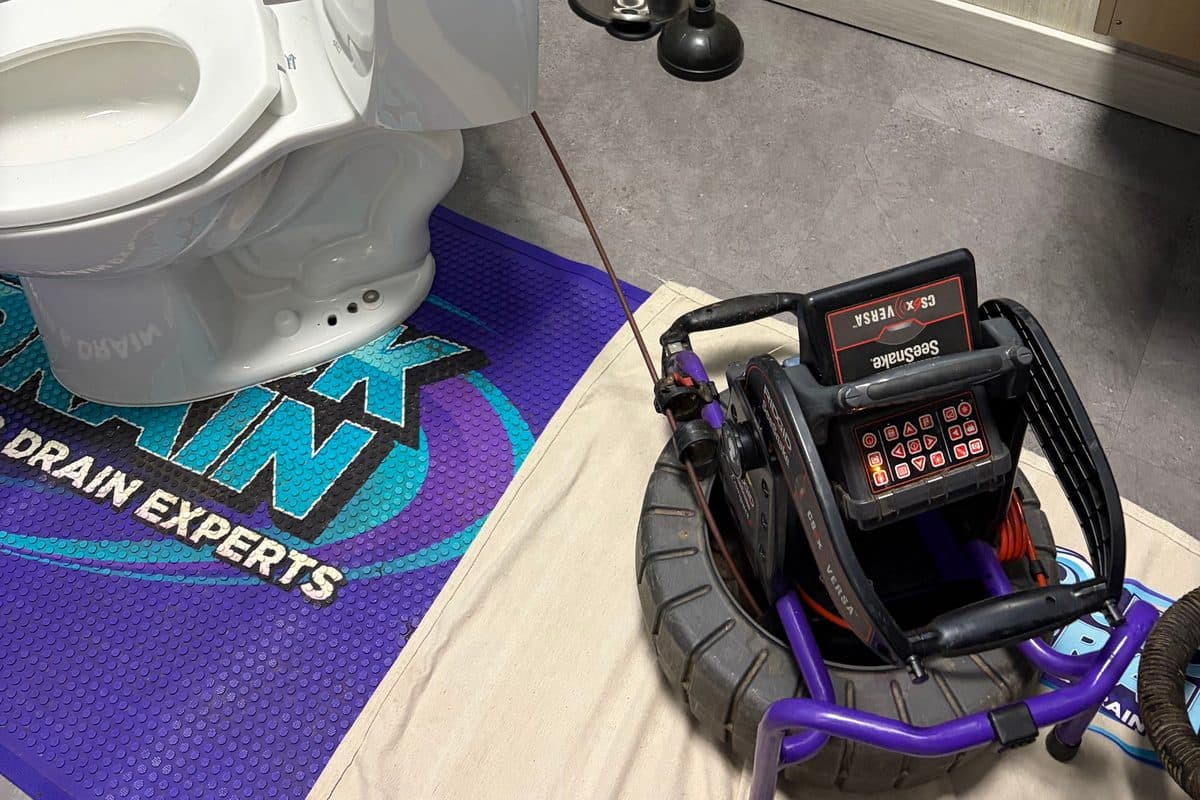
A waterproof camera on a push cable goes into your drain line through a cleanout, a pulled toilet or a roof vent, and records the inside of the pipe as it travels toward the street, the cesspool or the septic system. You see the same picture we do.
Behind the camera head is a 512 Hz sonde, a small transmitter our locator picks up from above ground. When the camera reaches a problem, we mark on the surface exactly where it is and how deep, so any repair is planned at the right spot instead of guessed at.
It's the first step of a diagnostics-first visit: the footage decides whether the honest answer is nothing at all, a cleaning, jetting, descaling or a repair.
When to get a camera inspection
- A drain that has backed up more than once
- Gurgling toilets or drains, an early warning of a partial blockage
- Before buying a home: the home inspector doesn't scope the sewer
- Before agreeing to any excavation or replacement quote, including ours
- Older homes with cast iron, clay or Orangeburg pipe
- Mature trees between the house and the street
- After an emergency clearing, to find out what caused it
How we run an inspection
Find the access point
We start at a cleanout if there is one. If not, we go in through a toilet flange or a roof vent. Drop cloths go down first.
Record the line
The camera travels the line from the house toward the street or the system, recording as it goes, so nothing depends on memory.
Locate what we find
At each defect we pick up the 512 Hz sonde from above ground and mark its position and depth.
Walk you through it
We go over the footage with you and explain each finding in plain English: what it is, whether it's urgent, and what your options are.
What we find under Long Island homes
Homes built before the 1970s often have cast iron that rusts from the inside; the scale narrows the pipe and catches grease. Homes from the 1940s to the 1960s may still have Orangeburg, a wood-fiber and tar pipe that softens, deforms and collapses with age. A camera is how you find out which one you have.
Sandy soil shifts and settles, which creates bellies and offset joints where waste collects. And the island's mature trees send roots into joints looking for water. Each of these looks like "a clog" from inside the house, and each one calls for a different fix.
What you get
- The video of your line, which is yours to keep
- The location and depth of each problem, marked on the surface
- A plain-English explanation of every finding: roots, offsets, bellies, grease, scale or collapsed pipe
- A recommendation based on what the video shows, with every option explained
- Evidence you can use in a real estate negotiation or an insurance claim