Mature trees are part of what makes Long Island’s older neighborhoods so appealing, and they are also behind a lot of sewer calls. Our October post covered the warning signs of roots in your sewer line and what fixes them. This one is about prevention: choosing trees, choosing spots, and living with the big tree you already have.
Why roots find sewer lines
Roots don’t hunt for pipes. They grow wherever the soil gives them water, air and nutrients. A sewer joint that has lost its seal leaks a little warm, nutrient-rich moisture into the soil, and fine roots follow it to the gap. Once inside, they grow into a mat that catches paper and grease. Sound pipe with tight joints rarely has a root problem; old clay, cast iron and Orangeburg lines often do.
Long Island’s sandy soil drains fast, so a steady source of moisture underground is especially attractive to roots in a dry summer.
The trees most often blamed
Extension services and sewer crews mention the same species again and again. Many of them are familiar in Long Island yards, parks and street plantings.
| Tree | Why it causes trouble |
|---|---|
| Willows | Fast growing and thirsty, with spreading roots that follow moisture; common near ponds and wet spots |
| Poplars and cottonwoods | Fast growth and wide, shallow root systems |
| Silver maple | Large, fast-growing, shallow roots; often named among the worst for pipes |
| Elms | Big trees with roots that find their way into drain lines |
| Sycamores and London planes | Very large at maturity, with big root zones |
| Sweetgum | Large tree with an extensive root system |
Big oaks and other large maples can cause the same problem when they are close to an old line. Size at maturity matters as much as species: a large tree near a leaking joint will eventually find it.
Smaller choices for yards with a sewer line
The University of Tennessee Extension’s guide to choosing trees near sewers recommends small, slower-growing trees and replacing them before they outgrow their space. Ornamental trees often suggested for spots near a line include:
- Flowering dogwood, a small native tree with spring flowers.
- Eastern redbud, small and early-blooming.
- Japanese maple, slow-growing and compact.
- Fringetree, a small native tree with white spring flowers.
None of these is root-proof. Keep even small trees off the line itself, and ask a local nursery or arborist which varieties suit your soil, sun and space.
Find the line before you plant
Most homeowners know roughly where the sewer line goes, and roughly is not good enough for a planting hole. A camera run from the cleanout, with the 512 Hz sonde behind the camera head, lets us trace the line from above ground and mark its path and depth on the lawn. If you are on a cesspool or septic system, mark the system and the line to it too. Our What’s Under My Home? tool is a quick first check of which you have.
Rules of thumb for spacing
- The bigger the tree will be at maturity, the farther from the line it belongs. Plan for the mature size, not the size in the pot.
- Published distance guidelines vary, so treat any single number as a minimum and go farther when the yard allows.
- Keep the strip over the line for lawn, groundcover or shallow-rooted perennials.
- Don’t plant over a cesspool, septic tank, leaching pool or drain field. The US EPA’s septic guidance also says to keep trees away from the system.
Already have a big tree over the line?
Don’t reach for the chainsaw first. The roots are in the pipe because a joint leaks, and removing the tree doesn’t seal the joint: other roots, or the next tree, will find it. Start with the pipe.
- Look. A sewer camera inspection shows which joint the roots come through, how much of the pipe they fill, and whether the pipe around them is sound.
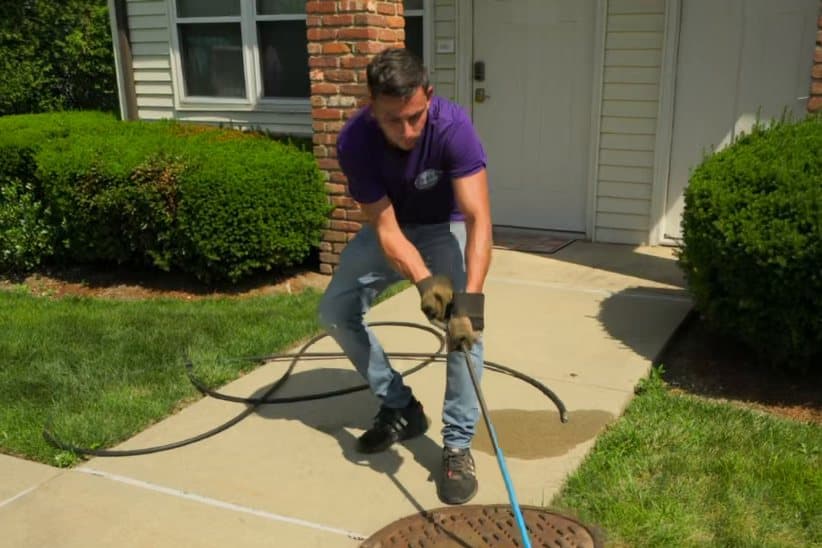
- Clear it properly. High pressure water jetting at 4000 PSI cuts roots back to the pipe wall and flushes them out. A snake only bores a hole through the middle; see hydro jetting vs. snaking.
- Keep it clear. If the pipe is sound, regular cleaning keeps roots from closing the line again. Quick Guard members get preventative jetting and priority scheduling.
- Fix the way in. A broken or offset joint can be repaired at that spot, which ends the cycle. The footage shows whether that is the right call.
Cesspools, septic systems and trees
On much of Long Island, especially in Suffolk, the line at risk runs to a cesspool or septic system rather than to the street. Roots can grow into the inlet pipe, into the joints of a leaching pool, and through a drain field. A system that drains slowly because of roots looks a lot like a full cesspool. A septic and cesspool inspection checks the line and the system together, so you don’t pay to pump a system when the real problem is the pipe.
A quick planting checklist
- Find and mark the sewer line, and the cesspool or septic system if you have one.
- Call 811 a few days before you dig.
- Choose a small, slow-growing tree for anywhere near the line, and a large tree only for spots well away from it.
- Plan for the tree’s mature spread, not its size today.
- If your home is older and the line has never been looked at, get it on camera first. Planting over a line with a leaking joint is inviting the problem in. Unsure about the symptoms you have now? Try the symptom checker.
Questions we get
Which trees have the most invasive roots for sewer lines?
Willows, poplars, silver maples, elms, sycamores and sweetgums are the species most often named by extension services and sewer crews. Any large tree close to an old line with a leaking joint can cause the same problem.
Are there sewer-safe trees?
Not completely. Small, slower-growing trees such as dogwood, redbud, Japanese maple and fringetree are lower risk, but they should still be kept off the line itself.
Should I cut down a tree that has roots in my sewer line?
Usually not as a first step. The roots got in through a leaking joint, and that joint stays open after the tree is gone. A camera inspection shows whether regular jetting or a repair at that joint is the better fix.
How do I find where my sewer line runs?
A camera inspection with a locating sonde traces the line from above ground and marks its path and depth. The emergency cost calculator gives likely ranges if the line is already backing up.
Can tree roots damage a cesspool or septic system?
Yes. Roots can enter the inlet pipe, the joints of a leaching pool and a drain field. Keep trees away from the system and the line to it.